Increasing Forces: Using the Kettlebell Swing to Increase Strength and Speed
those us involved in any kind of performance training this equation has to be at the forefront of everything we do. The ability to produce force quickly is essential to victory. This is why the vertical jump is so revered as a test for force production. To go from a stand still to leaping as high as possible shows a great ability to produce force quickly. In sprint terms this is a fast start; in grappling it is shooting for a takedown; and in lifting it is the start of the clean and the snatch.
And this is where most people get it wrong.
Producing force has as much to do with strength as it does with speed. Many chase after improvements in speed first instead of strength. Research shows, however, there are more potential gains in force production from strength development than there are from speed development. The Russians, and by extensionMel Siff and Tudor Bompa, knew this and all maintained that until you are squatting double bodyweight you have no need for speed work such as plyometrics.
There are three generally accepted ways to make you faster:
Use a heavy load and try to move it quickly. (In practice this doesn’t work very well. It is extremely difficult to stay focused on speed of movement during heavy lifts.)
Use almost no load and move quickly (jumping, bounding, etc.).
Use a light load of approximately thirty percent body weight and move it very fast using exercises such as power cleans.
Let’s jump forward a bit and assume you’ve actually done your homework, you do squat double bodyweight, and you are actually ready for some speed work. But let’s also be realistic and say that you’re a thirty-plus year old recreational athlete and you’ve maybe got some knee or ankle issues, and frankly spending time jumping up and down is probably going to do nothing other than hurt you and make you miss your game. How can we get jump improvements from speed work then?
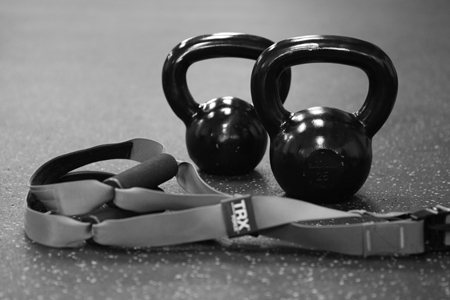
I hate to say it, but kettlebells to the rescue once again. There is now research to show that kettlebells can improve jump height too (which, incidentally, only mirrors studies done in cold war era Russia showing the same thing).
But instead of just talk about how swings help vertical jump, I think it’s more important to talk about the hows and whys of force production. I mentioned before that there are both load and speed factors in force production. I also wrote previously about various ways to test athletes to see whether they needed to do supplemental work on speed or strength
And this is where it gets interesting.
After a point using a heavier bell won’t allow you to continue increasing force production. It will increase strength, but after you reach that tipping point, no further force bonuses will occur, much the same as the squat example I gave above. Where that tipping point is for a person is difficult to tell without a force plate and some time on your hands to analyze data.
My super smart friend Brandon Hetzler, fromScience of the Swing, has done exactly this and found that a bell of roughly thirty percent of body weight is ideal for force production.Both heavier and lighter in this case diminish your ability to move it quickly enough. Brandon found that the 32kg bell (he weighs 100kg) saw his force production jump fourteen percent from the 24kg bell. While adding load to either 40kg or 48kg saw it drop by a total of ten percent.
So, we’ve seen that this thirty percent margin is ideal for producing the most force with swings, and we also have studies to show that the swing does lead to increases in jump height (And, I might add, are much safer than extra jumping for athletes who may already be high risk due to their sport. And the first rule of coaching should be to never hurt your athletes or expose them to more risk than necessary outside their games).