
• Increasing Forces: Using the Kettlebell Swing to Increase Strength and Speed

    Contributor – Master RKC, Athletic Adventurer

    those us involved in any kind of performance training this equation has to be at the forefront of everything we do. The ability to produce force quickly is essential to victory. This is why the vertical jump is so revered as a test for force production. To go from a stand still to leaping as high as possible shows a great ability to produce force quickly. In sprint terms this is a fast start; in grappling it is shooting for a takedown; and in lifting it is the start of the clean and the snatch.

    And this is where most people get it wrong.

    Producing force has as much to do with strength as it does with speed. Many chase after improvements in speed first instead of strength. Research shows, however, there are more potential gains in force production from strength development than there are from speed development. The Russians, and by extensionMel Siff and Tudor Bompa, knew this and all maintained that until you are squatting double bodyweight you have no need for speed work such as plyometrics.

    There are three generally accepted ways to make you faster:

    Use a heavy load and try to move it quickly. (In practice this doesn’t work very well. It is extremely difficult to stay focused on speed of movement during heavy lifts.)

    Use almost no load and move quickly (jumping, bounding, etc.).

    Use a light load of approximately thirty percent body weight and move it very fast using exercises such as power cleans.

    Let’s jump forward a bit and assume you’ve actually done your homework, you do squat double bodyweight, and you are actually ready for some speed work. But let’s also be realistic and say that you’re a thirty-plus year old recreational athlete and you’ve maybe got some knee or ankle issues, and frankly spending time jumping up and down is probably going to do nothing other than hurt you and make you miss your game. How can we get jump improvements from speed work then?

    I hate to say it, but kettlebells to the rescue once again. There is now research to show that kettlebells can improve jump height too (which, incidentally, only mirrors studies done in cold war era Russia showing the same thing).

    But instead of just talk about how swings help vertical jump, I think it’s more important to talk about the hows and whys of force production. I mentioned before that there are both load and speed factors in force production. I also wrote previously about various ways to test athletes to see whether they needed to do supplemental work on speed or strength

    And this is where it gets interesting.

    After a point using a heavier bell won’t allow you to continue increasing force production. It will increase strength, but after you reach that tipping point, no further force bonuses will occur, much the same as the squat example I gave above. Where that tipping point is for a person is difficult to tell without a force plate and some time on your hands to analyze data.

    My super smart friend Brandon Hetzler, fromScience of the Swing, has done exactly this and found that a bell of roughly thirty percent of body weight is ideal for force production.Both heavier and lighter in this case diminish your ability to move it quickly enough. Brandon found that the 32kg bell (he weighs 100kg) saw his force production jump fourteen percent from the 24kg bell. While adding load to either 40kg or 48kg saw it drop by a total of ten percent.

    So, we’ve seen that this thirty percent margin is ideal for producing the most force with swings, and we also have studies to show that the swing does lead to increases in jump height (And, I might add, are much safer than extra jumping for athletes who may already be high risk due to their sport. And the first rule of coaching should be to never hurt your athletes or expose them to more risk than necessary outside their games).


  • Brian MacKenzie’s Controversial New Approach to Marathon Training

    The results were stunning. By several key measures of exercise performance—number of mitochondria (an indicator of how efficiently a muscle is using oxygen), buffering capacity against lactic-acid buildup, and the presence of glycogen (sugar) for fuel—the groups “showed remarkably similar improvements in exercise performance.” The difference: one group exercised for more than 10 hours, the other for only 15 minutes. In another study, just two weeks of sprints nearly doubled cyclists’ endurance when they pedaled at a fairly vigorous pace, from 25 to 50 minutes.

    By Christopher Solomon

    Read More: OutsideOnline


  • 7 Reasons You Need to Try Kettlebells

    Kettlebells are the cannonball-shaped workout tools you should add to your routine if you want to get a leaner, tighter figure without spending much time. If you’ve seen these handled weights at your gym but avoided them because you didn’t know what to use them for, you’ve come to the right place.

    We quizzed Lorna Kleidman, three-time kettlebell sport world champion, kettlebell instructor in New York City, author of Body Sculpting With Kettlebells for Women, on the ins and outs of shaping up with kettlebells.

    A former gym rat who spent as much as two hours a day going to different fitness classes, Kleidman discovered kettlebell workouts six years ago and was able to cut her workout time by nearly two-thirds even as her body became leaner than ever.

    Read More: Fox News


  • Kettlebells help athletes strengthen core and improve flexibility

    They look like cannonballs, but work like a charm.

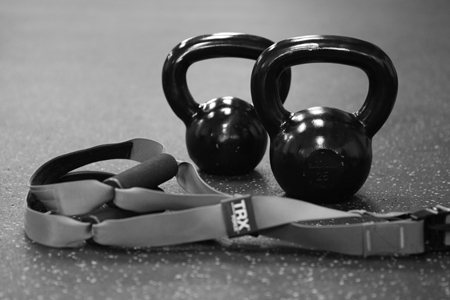
    Kettlebells, those squatty steel or cast iron weights topped with a loop-shaped handle, are popping up in gyms all over Austin. Experts say the old-school weightlifting tools, developed in Russia in the 1700s, can boost cardiovascular fitness, increase flexibility and build strength without adding bulk.

    “There’s not a reason not to swing,” says Chris Hartwell, head of the Kettlebell Underground program at RedBlack Gym on Burnet Road, an offshoot of CrossFit Central.

    Hartwell is leading a mid-day kettlebell class on a chilly January day. Eminem blasts in the background and a brisk breeze flows through the open-air gym. A dog lolls in the sunshine out front, as two women grunt and push weighted metal sleds up and down the sidewalk.

    Inside, metal clangs and sweat flies. I try not to quiver as I sidle into class.

    By Pam LeBlanc
    Read More: Statesman


  • Total body toning with kettle bells

    If you’ve eyed a cast-iron kettlebell at your gym and couldn’t imagine a use for it beyond doorstop, keep reading.

    Researchers found that people who did 20-minute kettlebell workouts torched almost 300 calories—and that’s just for starters. When you factor in the muscle-sculpting impact (the calories burned after you exercise as your body repairs its muscle fibers), the total expenditure could increase by up to 50 percent.

    Kettlebells also make traditional dumbbell moves more challenging. Their weight isn’t evenly distributed, so your stabilizer muscles have to work harder.

    By Jen Ator
    Read more: Fox News

  • American Council on Exercise (ACE) Study

    The American Council on Exercise (ACE), America’s leading authority on fitness and one of the largest fitness certification, education and training organizations in the world, today announced key findings from an exclusive study on the benefits of kettlebell workouts conducted with the University of Wisconsin, La Crosse, through its exercise and health program. Results concluded that kettlebells provide a much higher-intensity workout than standard weight-training routines and offer superior results in a short amount of time.

    “The use of kettlebells has grown immensely over the past few years, as they can offer a great bang for your buck when it comes to time spent exercising and quality of results,” says ACE’s Chief Science Officer Cedric X. Bryant , Ph.D. “A person can easily burn several hundred calories in a brief period of time using these iron orbs, which makes them appealing to those looking for time-efficient results.”

    Read More: PR NEWSWIRE